
Why the 20th of Every Month Matters for Sellers (Reconciliation Deadline Explained)
9 min read
The 20th of every month is the day smart sellers sit down and check last month's money. It gives you a 10-day window to catch missing payments, damaged returns, and hidden charges before it is too late to claim them back.
Why the 20th of the month is a special date for sellers
If you sell on Amazon, Flipkart, or Meesho, mark the 20th of every month on your calendar. This is not a random date. By the 20th, most of last month's orders have already reached one of three final stages — delivered and kept by the customer, delivered and returned, or lost/damaged in transit. This means the 20th is the first day you can look at last month's full picture with confidence.
The 20th also starts a 10-day window. In these 10 days, before the month closes and moves into the next cycle, you can still raise claims for missing money, check which products (SKUs) sold well and which did not, and spot hidden charges that quietly ate into your profit. Miss this window, and many marketplaces make it very hard, or even impossible, to get that money back.
What is reconciliation, in simple words
Reconciliation simply means matching two things: what you expected to get paid, and what you actually got paid. You sold a product for ₹500. The marketplace takes commission, shipping fee, and other charges. What is left should land in your bank account. Reconciliation is the act of checking that this final number is correct — not too low, not missing, not delayed without reason.
Most sellers never check this. They only look at the total amount that came into their bank account and assume it is correct. But settlement reports are long, complicated, and full of small deductions. A missing payment of ₹200 on one order looks small. But multiply that across hundreds of orders every month, and it becomes real money that you are losing without knowing it.
A simple example: how one order travels from January to February
The biggest confusion sellers have is this: 'I sold the product in January, so why is my money still not fully settled in February?' The answer is that a single order does not finish its full journey in the same month it was dispatched. Let us walk through one real example, step by step, in plain language.
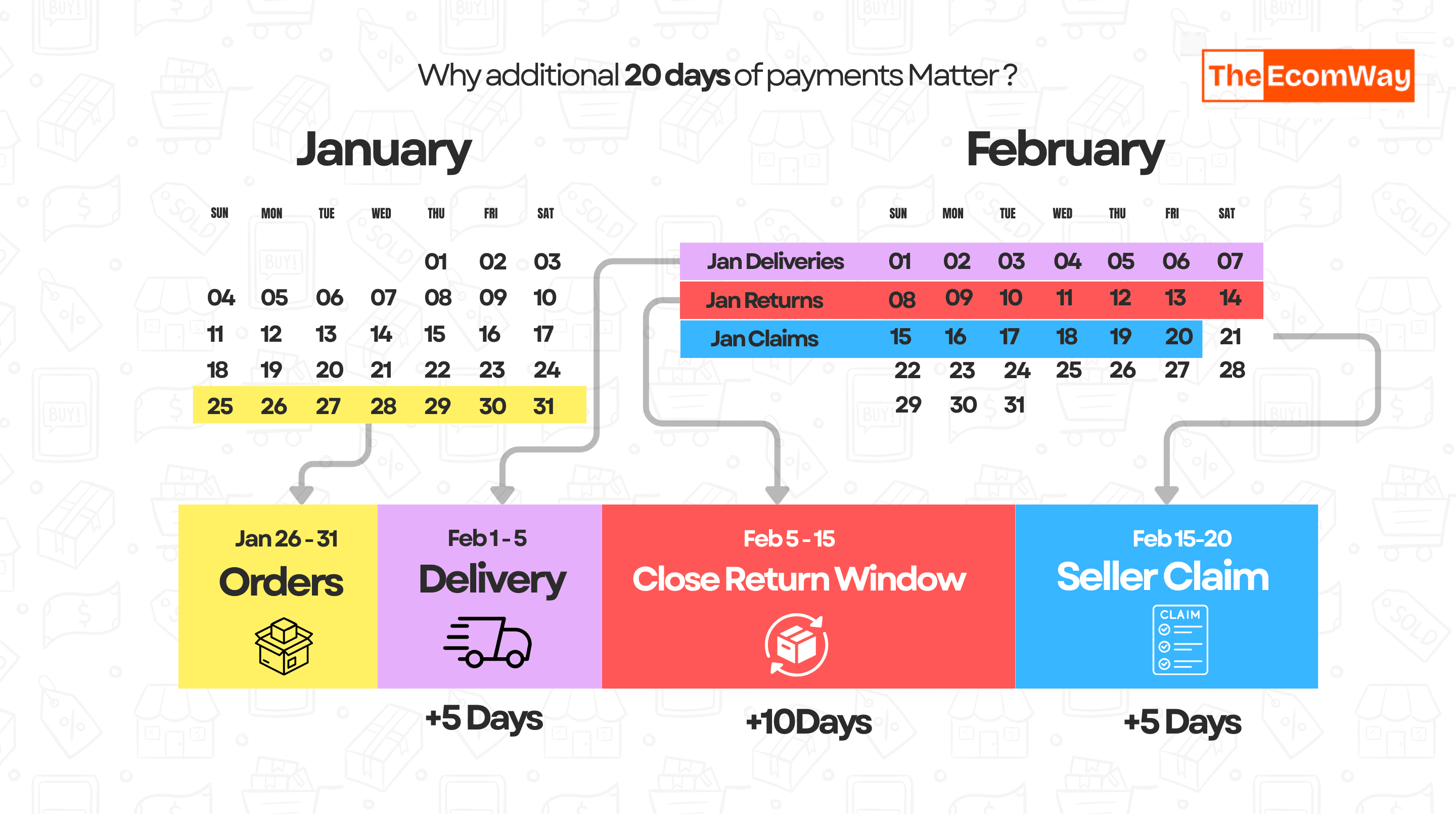
- Week 4 of January — You dispatch (send out) the order to the customer. This is the day you mark as 'sold' in your own records.
- Week 1 of February — The order actually reaches the customer's hands. There is always a gap of a few days to more than a week between dispatch and delivery, especially for far-away pin codes.
- Week 2 of February — The customer now has 7 to 10 days to decide if they want to keep the product or return it. If they choose to return it, the marketplace automatically deducts that amount from your next payment. This deduction can happen even before you know the return has started.
- Week 3 of February — If the customer's returned product comes back damaged, opened, used, or is simply the wrong item, this is usually when it physically reaches your warehouse or the marketplace's return center. This is your chance to raise a claim and get compensation for the damaged product.
Why sellers need a three-week safety gap
From the example above, you can see the full order life cycle: dispatch, delivery, return decision, and return condition check can easily take three weeks or more. This is why looking at your sales numbers on the same day you dispatch an order tells you almost nothing useful. The real, final picture of a month's sales is only clear about three weeks after the month ends.
This is exactly why the 20th of the month works so well as a reconciliation date. By the 20th, orders dispatched even in the last week of the previous month have usually finished their full journey — delivered, return window closed or return already processed, and any damage claims ready to be raised. Checking any earlier means you are looking at incomplete, half-finished data.
What exactly should you check during this 10-day window
The 10 days after the 20th are not just for looking at numbers. This is your action window. Here is what to check, one by one:
- Payment match — For every order, check if the amount you received matches what you expected after commission and fees. If it is lower with no clear reason, that is a short settlement, and you need to raise it.
- Missing payments — Some orders show as 'delivered' in your order report but the payment never shows up in your settlement report at all. This is one of the most common ways sellers lose money without noticing.
- SKU performance — Look at which products (SKUs) actually made you profit after all deductions, and which ones are quietly losing you money because of high return rates or high shipping charges. This is the only time you get a true, settled picture, not just a raw sales number.
- Hidden charges — Look for extra deduction lines with vague names like 'adjustment,' 'penalty,' or 'other charges.' These are often not explained clearly and are easy to miss if you only glance at the final total.
- Damaged or wrong returns — If a returned product came back broken, used, or was swapped by the customer, this is your window to raise a claim for compensation before the marketplace's deadline passes.
Why waiting past the window can cost you real money
Every marketplace — Amazon, Flipkart, and Meesho — puts a time limit on how long you can wait before raising a claim for a missing payment or a damaged return. These limits are not the same everywhere, and they are usually shorter than sellers expect. Once this time limit passes, the marketplace has no obligation to investigate or pay you back, even if the mistake is clearly on their side.
This is the real danger of not reconciling every month. It is not that mistakes will stop happening if you ignore them — mistakes happen anyway. It is that you lose your legal right to claim that money back, permanently, simply because you checked too late. The 20th-of-the-month habit exists to make sure you are always checking well inside the claim window, not after it has quietly closed.
A simple checklist you can follow every month
You do not need to be an accountant to do this. Follow this simple monthly routine:
- On the 20th, download last month's settlement report and last month's order report from your seller panel.
- Match every order, one by one, against the payment you actually received for it.
- Make a short list of anything that looks wrong — missing payment, lower payment, unexplained charge, or damaged return.
- Raise a claim or support ticket for each issue on your list, inside the 10-day window, before the month closes further.
- Note down which SKUs performed well and which did not, so you can make better stocking decisions next month.
Doing this by hand every month is hard — here is the easier way
The biggest reason sellers skip reconciliation is not that it is impossible — it is that doing it by hand, every single month, for hundreds of orders across multiple marketplaces, takes hours of tiring spreadsheet work. Most sellers give up halfway through the settlement file and just hope the total number is close enough to correct.
This is exactly the gap TheEcomWay's reconciliation engine is built to close. It automatically matches your orders against your settlement files for Amazon, Flipkart, and Meesho, and flags short payments, missing payments, hidden charges, and unreimbursed damaged returns for you — every cycle, well inside the claim window. Instead of spending your 10-day window buried in spreadsheets, you spend it acting on a ready list of issues that are already found for you.
Related comparisons
Frequently Asked Questions
Why is the 20th of the month specifically important for sellers?
By the 20th, most orders dispatched even in the last week of the previous month have completed their full journey — delivered to the customer, past the return decision window, and any damage checks done. This makes the 20th the first date each month when you can reconcile last month's sales with a complete, settled picture instead of half-finished data.
What does the 10-day window after the 20th mean?
It is the practical time you have to check last month's numbers and raise any claims for missing payments, short settlements, or damaged returns before the marketplace's claim deadlines start running out and before the next month's cycle takes over your attention.
If I dispatch an order in January, when is it actually settled?
Not in January. A typical path is: dispatch in the last week of January, delivery in the first week of February, a 7-to-10-day return decision window in the second week of February, and if the item is returned damaged, that reaches you around the third week of February. This is why checking too early gives you an incomplete picture.
What happens if a customer returns a product after I already got paid?
The marketplace automatically deducts that amount from a future payment cycle. This is normal, but it means a later month's payout can look smaller than expected for a completely valid reason — one more reason to actually reconcile the numbers instead of just glancing at the total.
What counts as a 'hidden charge' in a settlement report?
Any deduction line that is not clearly explained, such as vague labels like 'adjustment,' 'penalty,' or 'other charges.' These are easy to miss because settlement reports are long, and they quietly reduce your final payout if you never check the report line by line.
What happens if I miss the marketplace's claim window?
The marketplace is no longer required to investigate or refund the issue, even if the mistake is clearly on their end. This is the real cost of skipping monthly reconciliation — not that errors happen, but that you permanently lose the right to recover the money once the deadline passes.
Do I need special software to reconcile every month?
No, it can be done manually with spreadsheets, but it takes real time and is easy to get wrong at higher order volumes. Tools like TheEcomWay's reconciliation engine automate the matching between your orders and settlement files so you can spend your 10-day window acting on issues instead of hunting for them.
Should I check SKU performance only once a month?
The 20th-of-the-month check is when you get the most accurate, settled picture of SKU performance, since returns and deductions have mostly been processed by then. You can still glance at raw sales more often, but treat the monthly reconciliation numbers as the real, trustworthy figures for decisions like restocking or dropping a product.